What “royalties” means
When someone plays your track on Yandex Music, a Russian streaming service, the platform receives money from their subscription, or advertising revenue if they listen for free. Part of that money is due to you. That payment is a royalty: compensation for the use of music.
The complication is that your share is not a fixed amount. What you receive for one stream depends on several factors: the listener’s country, their subscription type, the platform’s revenue that month, and your share of total listening. This is why royalties can be confusing. People look for a single price per stream, but platforms do not have one.
Two types of royalties, two different payments
Before looking at rates, distinguish the two types of royalties a streamed track generates:
- Publishing royalties pay for the music and lyrics. They go to the composer and lyricist, even if someone else performs the song.
- Master royalties pay for a particular sound recording. They go to the performer and recording rights holder; this is the share a distributor passes on to the artist.
If you wrote and recorded the track yourself, both types are yours, less the distributor’s commission. If you perform someone else’s song as a cover, publishing royalties still belong to the original songwriters. You also need the necessary license to release that performance legally.
The revenue pool: how royalties are calculated
The model used by Spotify, Apple Music, Yandex Music and VK Music is called pro rata, meaning “in proportion.” Imagine a pool containing the platform’s subscription and advertising revenue for a month. That pool is divided among rights holders in proportion to their share of total streams in that month.
Your stream’s value therefore depends on the money in the pool and how many streams all artists received, rather than a published price per play. A paying subscriber can generate considerably more for you than a free listener: subscription fees feed the pool directly, while free listening is funded by the much smaller advertising revenue.
An alternative is a user-centric model, where each listener’s payment is shared only among the artists they actually listen to rather than entering a platform-wide pool. Deezer is one example of a service using an alternative approach at scale. The main platforms in Russia use pro rata, so that is the mechanism that shapes earnings in this market.
How to read a royalty report
- 1Select the usage period
Keep the month of listening separate from the month the earnings were credited.
- 2Separate master and publishing income
A distributor’s report usually shows the recording rights holder’s income. Publishing royalties may arrive through another channel.
- 3Check the platform and territory
The same number of streams can earn different amounts in different countries and access tiers.
- 4Calculate an effective rate
Divide a report line’s income by its counted streams. This describes that period, rather than setting a future rate.
- 5Apply your contract terms
Check commission, the label’s share, taxes, payout thresholds and withdrawal fees.
Why payments take time
Between a stream and money in your account is a chain: platform → distributor → artist. Each step takes time.
- The platform closes its reporting period, usually a calendar month, and prepares a report.
- About a month after the period ends, the report and payment reach the distributor.
- The distributor then credits the artist’s royalties.
Overall, the average time from a stream to an available payment is 2–3 months. Platform accounting and checks for artificial streaming can make it longer. This is a standard industry cycle rather than a feature of one service. Treat promises of next-day streaming payments with care.
Why “the price of 1,000 streams” can mislead
There is no fixed price for a play. Spotify, for example, explicitly says it does not pay a fixed per-stream rate. It first calculates net revenue, then the rights holder’s share of streams, known as streamshare. Agreements among the platform, distributor, label and artist further affect the amount an individual receives.
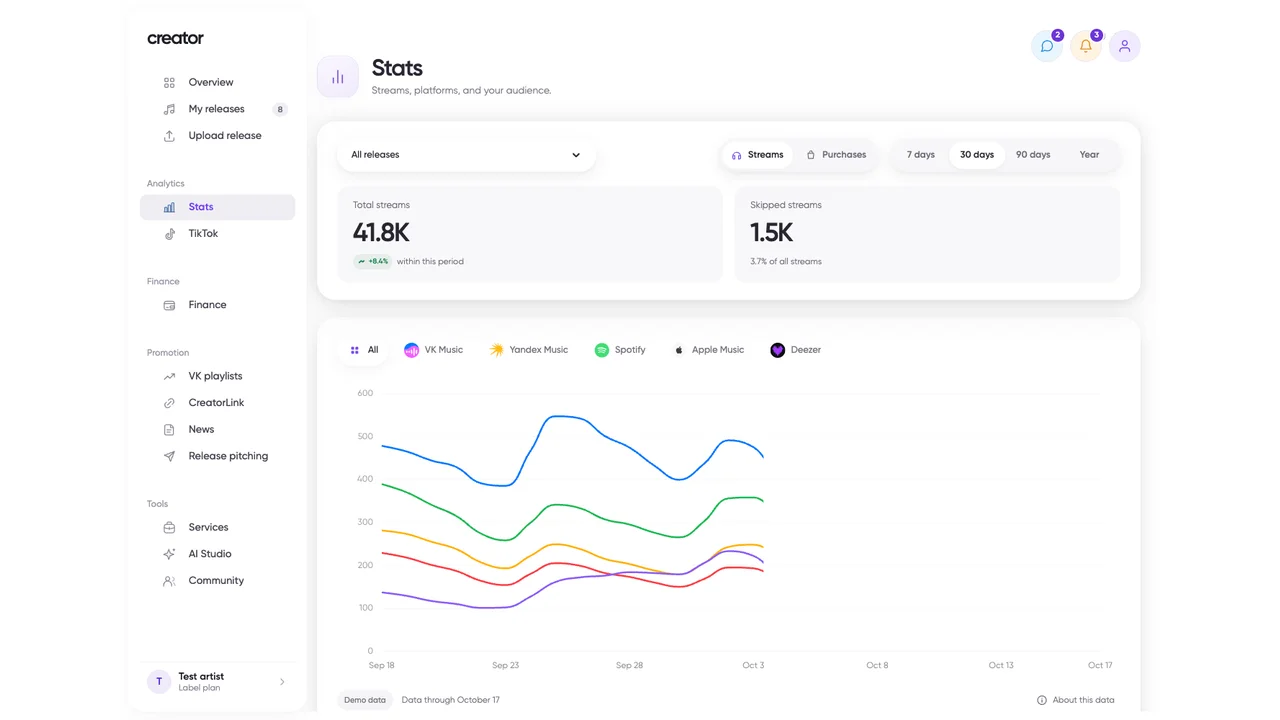
A useful benchmark comes from your own reports. Take earnings for one platform, territory and period, divide them by counted uses, and you have an effective rate for that past period. For forecasts, use a range from several reports and apply your contractual royalty share separately.
Platforms do not publish an official per-stream rate; these are commercial terms. Figures in comparison tables are estimates from independent market analysis rather than a price list.
Avoid comparing platforms using someone else’s screenshot without knowing the territory, period, currency and contract level. Those are four separate sources of error in one calculation.
Why stream counts alone promise nothing
The same number of uses can generate different earnings depending on territory, access type, reporting period and contract terms. A financial goal is more useful when it focuses on growing your audience and an effective rate calculated from several of your own reports.
The useful metric: earnings before commission divided by counted uses in one report line. Compare matching platforms, territories and periods.
Payout thresholds and your back catalog
Most distributors, including creator, hold royalties in an artist balance until the minimum withdrawal amount is reached. The Russian-market example discussed here uses a threshold of a few thousand rubles; see current international plans for USD thresholds. This avoids sending tiny transfers whose bank fees could outweigh the payment itself. Earnings below the threshold do not disappear; they remain in your balance until you can withdraw them.
Another point is easy to miss: royalties follow the listening date rather than the release date. A track released a year ago keeps earning while people listen, and that income follows the same chain with the same 2–3 month delay. An older catalog that continues to attract streams earns through the same process as a new release, just without the initial release-month spike.
Putting this into practice
Royalties are a continuing income stream that grows with consistent listening. Three practical points follow from the process above:
- Plan for a 2–3 month payment cycle rather than expecting money immediately.
- Treat other people’s “payment per 1,000 streams” figures as broad estimates, shaped in part by listener geography.
- Calculate your own royalty share after the distributor’s deductions. That determines what reaches you.
For more on how your share changes between subscription and royalty-commission models, read our guide to free music distribution.